NASA has opened what may become the most significant commercial market beyond Earth orbit. At an event at Kennedy Space Center on Saturday, the agency announced that eight companies will be eligible for its new lunar delivery program, a 10-year contract that tops out at $10 billion across all of them.
The companies are Blue Origin, Firefly Aerospace, Intuitive Machines, ispace-U.S., Lockheed Martin Space, Northrop Grumman Space Systems, SpaceX and Voyager Technologies. “We are building the Moon Base mission by mission,” NASA Administrator Jared Isaacman said.
How the contract works
The program is called CLPS 2, a successor to Commercial Lunar Payload Services. It is important to understand what kind of deal this is. NASA is not handing $10 billion to anyone. It is a multiple-award contract: the eight firms become approved vendors and then compete for individual delivery orders as NASA needs them. The $10 billion is the ceiling on what could be spent across all of them over a decade.
Any company’s actual revenue depends on winning those orders and carrying them out. It is entirely possible for a company on this list to receive very little.
The first version of the program shows how these things grow. It began with a maximum of $2.6 billion and has since been raised to $4.2 billion. It runs through November 2028, with deliveries allowed through November 2033.
The rest of the package
NASA paired the lander announcement with several other awards aimed at its planned base near the lunar South Pole.
- A nuclear-powered rover. The six-wheeled PROMISE rover, managed by NASA’s Jet Propulsion Laboratory and reusing spare hardware from the Curiosity and Perseverance Mars programs, is targeted to launch in late 2028. Blue Origin won a $94 million base contract, with options worth up to $140 million, to deliver it on its Mark 1 lander.
- Launch and transportation. Six task orders worth about $1.3 billion combined were split among Blue Origin, Impulse Space and Arrow Science and Technology under a separate contract, for missions that include a lunar navigation test and scouting drones.
- Communications. SpaceX will launch communications satellites on Starship to the space around the Moon in 2028 as a demonstration.
- Power. A solar and communications tower called miniCAST will use components from Honeybee Robotics, a Blue Origin company, along with Redwire and Yank Technologies.
Who looks best placed
Blue Origin had the most visible day, winning the rover delivery and launch work and supplying components through a subsidiary. SpaceX, already building a lander for NASA astronauts, added another line to a long list of agency programs.
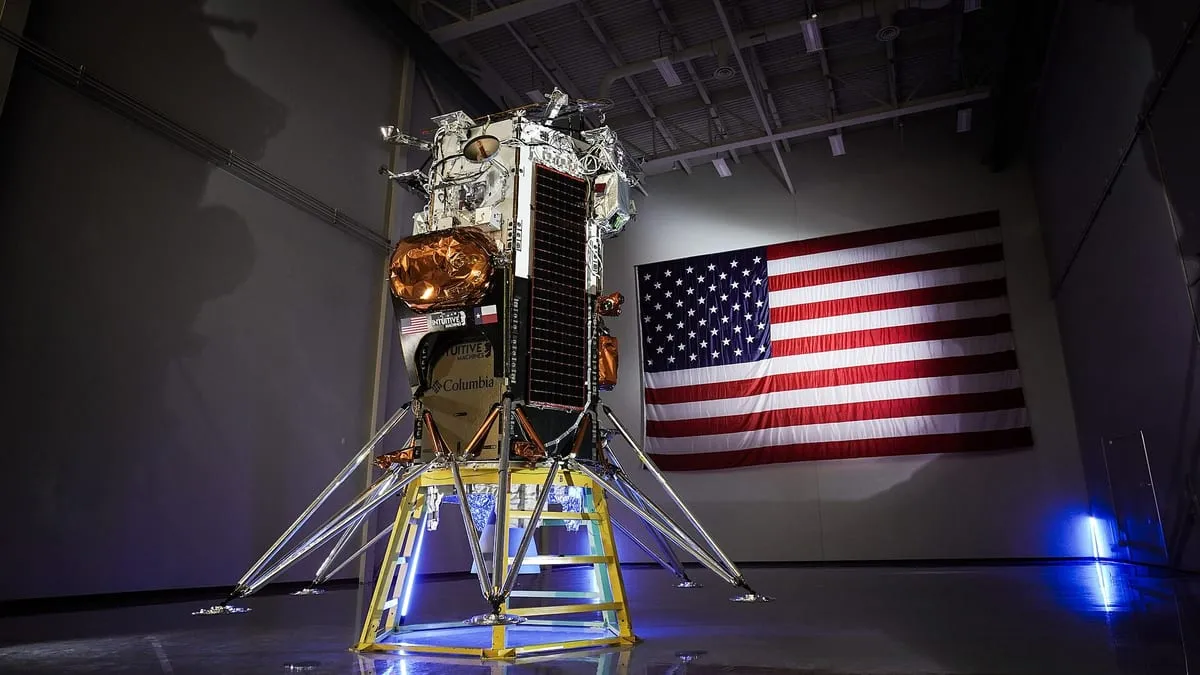
For the smaller firms, this matters even more. Intuitive Machines and Firefly built their business stories around lunar missions, and government orders are still the main source of demand. There is little private commercial market on the Moon yet, and no assurance when one will appear.
Track record will count. Lunar landings remain hard. Astrobotic’s Peregrine failed in January 2024 before reaching the Moon. Intuitive Machines made the first American soft landing since Apollo in February 2024, but its lander tipped over, and a second attempt in March 2025 ended the same way. Firefly’s Blue Ghost landed successfully and operated on the surface in March 2025. Astrobotic, one of the early participants in the program, is not among the eight named in this round.
Why NASA is buying rides
The approach reflects a long shift at the agency. For most of its history NASA designed and owned the spacecraft it flew. Under commercial programs it instead buys a service, a delivery or a launch, at a set price, and leaves the hardware to the contractors. The model worked in low Earth orbit, where SpaceX’s cargo and crew flights to the space station became routine.
The bet is that competition will drive down costs on the Moon as well, and that companies will take on more of the development risk. The downside is that fixed-price deals can leave small companies exposed when things go wrong, and in space, things go wrong.