Late autumn and early winter bring two of the year’s notable meteor showers, the Leonids in November and the Geminids in December. You don’t need a telescope, binoculars or any special equipment to see them, just a dark sky, warm clothes and some patience. And in 2026, the Moon is on viewers’ side for the better of the two.
What a meteor shower is
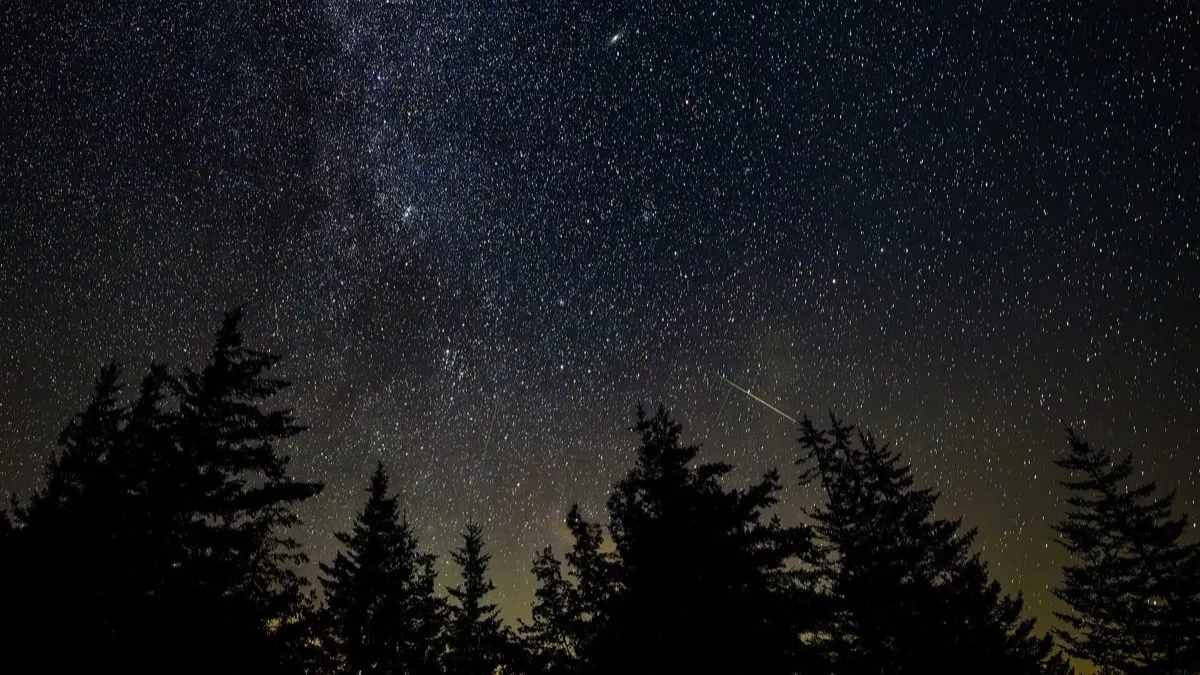
Meteors, often called shooting stars, are tiny bits of rock and dust, most no bigger than a grain of sand, burning up as they hit Earth’s atmosphere at tens of thousands of miles per hour. A meteor shower happens when Earth passes through a stream of debris left behind by a comet or an asteroid. Because Earth crosses the same streams at the same point in its orbit every year, showers return on roughly the same dates.
The meteors in a shower all appear to come from one point in the sky, called the radiant. Each shower is named after the constellation where its radiant sits.
The Leonids: around November 17
The Leonids come from debris left by Comet Tempel-Tuttle and appear to radiate from the constellation Leo. In a typical year they are modest, with perhaps 10 to 15 meteors an hour under dark skies at the peak, but their meteors are among the fastest of any shower and sometimes leave glowing trails.
The Leonids are famous for occasional storms. When Earth passes through an especially dense part of the stream, rates can soar to thousands of meteors an hour, as happened in 1833 and 1966, and a strong display was also seen around 1999 to 2001. No storm is expected this year.
In 2026, the Moon will be around half full near the peak and will set around midnight. The best viewing is after the Moon sets, in the dark hours before dawn, when Leo has risen high in the eastern sky.
The Geminids: the night of December 13 to 14
The Geminids are usually the strongest shower of the year. Under a dark, clear sky at the peak, observers can see well over 100 meteors an hour, and many are bright and slow-moving, which makes them easy to spot.
Unusually, the Geminids come from an asteroid, called 3200 Phaethon, rather than a comet. Their radiant is in the constellation Gemini, which rises in the early evening, so unlike most showers they are worth watching from mid-evening onward, not just before dawn.
2026 is a particularly good year. Around the peak the Moon is only a thin crescent, roughly a quarter lit, and it sets in the evening. That leaves a dark sky for most of the night. The best rates usually come after about 10 p.m. local time and continue until the early morning hours, when the radiant is highest.
Bonus: the Quadrantids in early January
The Quadrantids, peaking around January 3 to 4, can rival the Geminids for a few hours, but their peak is very short and easy to miss. In early 2027 a waning crescent Moon will rise in the hours before dawn, so the sky should be reasonably dark for a good part of the night.
How to watch
- Get away from lights. City lights wash out all but the brightest meteors. A park or rural spot even 30 minutes outside town can make a huge difference.
- Give your eyes time. It takes about 20 to 30 minutes for your eyes to fully adjust to the dark. Avoid looking at your phone; if you need light, use a dim red one.
- Look at a wide area of sky. Meteors can appear anywhere. Looking about halfway up from the horizon, away from the Moon, often works best.
- Get comfortable. A reclining camp chair or a blanket on the ground lets you watch the whole sky without straining your neck.
- Dress for winter. Standing still on a December night gets cold quickly. Wear more layers than you think you need, plus a hat and gloves.
- Be patient. Meteors come in bursts and lulls. Plan to watch for at least an hour.
Photographing meteors
To photograph them, use a camera or phone that can take long exposures on a tripod, set to its night or manual mode. Point it at a wide area of dark sky and take continuous exposures of several seconds to half a minute. You will capture many frames with nothing in them, and that’s normal.
What we think
If you only make the effort once this season, choose the Geminids on the night of December 13 to 14. A reliable shower, many bright meteors and a nearly moonless sky make this year’s peak one of the best opportunities in recent years.
Weather is the only thing nobody can control. Check the cloud forecast a day or two ahead, and if the peak night is cloudy, the nights just before and after can still offer a good show.