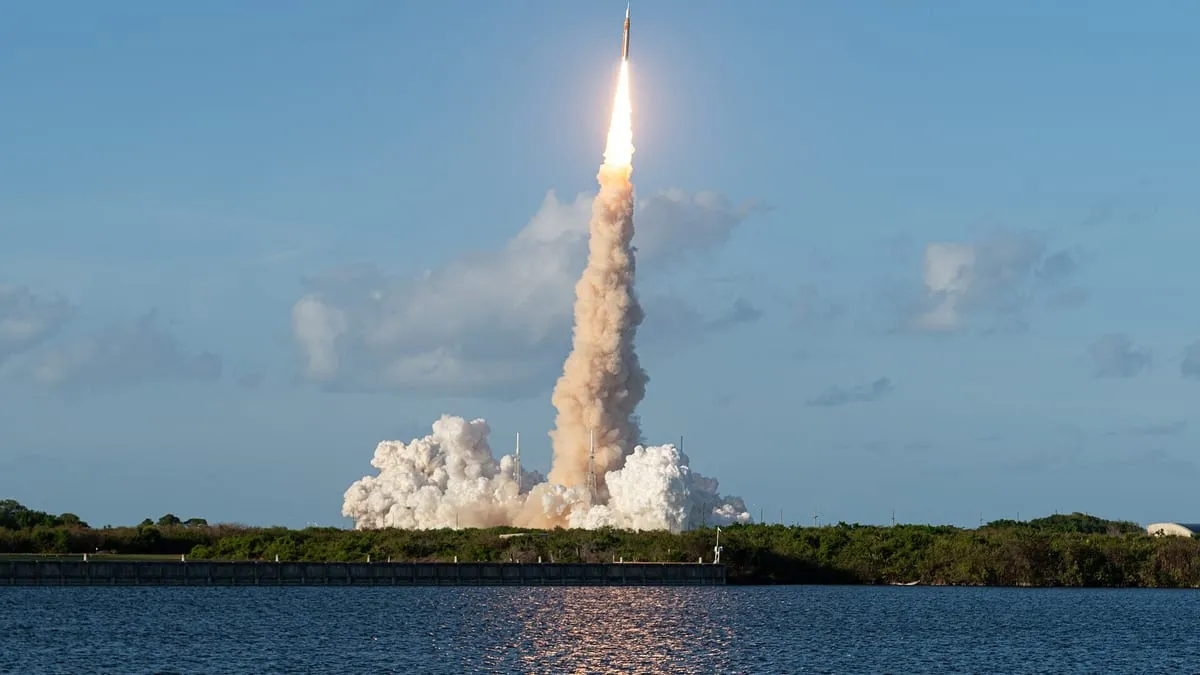
The most powerful moment of NASA’s Artemis II mission, the April 1 liftoff, was not the one that disturbed the upper atmosphere most. An engine burn about an hour later was, and its ripples spread across most of North America.
That’s the finding of a study led by researchers at National Cheng Kung University in Taiwan, with Charles Lin as corresponding author. It appeared in July as a preprint in Geophysical Research Letters and drew wide coverage this month. Hackaday called the effect “anthropogenic space weather.”
How do you measure the sky with GPS?
The ionosphere is the electrically charged layer of the upper atmosphere. Its free electrons slow radio signals slightly, and GPS signals pass through it on the way to your phone, which is why the Federal Aviation Administration notes that the ionosphere can affect location readings.
That delay is what the team used. By timing how long GPS signals took to reach existing ground stations, they reconstructed how the rocket’s passage changed the concentration of free electrons, and when. No new instruments were needed.
Which part of the flight mattered?
There were three separate disturbances. Liftoff caused the first. The second came about an hour after launch, from the “apogee raise burn” that lifted the spacecraft’s orbit. About 25 hours in, the trans-lunar injection burn that sent the crew toward the Moon produced the third.
The second one dwarfed the rest. According to the authors, it “triggered shock waves and unprecedented large-scale disturbances that elongated 50° longitude across North America,” which Newsweek puts at roughly 2,500 miles at typical US latitudes. Lin told Newsweek it covered “almost the entire U.S. continent,” the largest such area ever recorded.
The power figures make that stranger. Liftoff pushed with roughly 80 times more force than the second burn, Lin said, and 318 times more than the third. The later, smaller burns still caused stronger disturbances, because the spacecraft was by then already high above Earth.
Space.com reports the effect was up to ten times stronger than what was seen after SpaceX’s Starship test launches, even though Starship has about twice the liftoff thrust of NASA’s rocket.
Did anyone’s GPS fail?
No outage was reported. BBC Sky at Night says the team found no widespread GPS disruption from the liftoff itself.
What the ground stations did record were changes equal to positioning errors of several meters, Space.com reports. Lin told Newsweek those matter only if receivers don’t correct for the ionosphere. The team also suspects the shock front briefly disrupted some radio communications.
For a sense of scale, GPS.gov says a smartphone is typically accurate to within about 4.9 meters under open sky. That’s why the researchers point to drones and self-driving cars, which need tighter positioning than a phone’s map does.
“A positioning error of a couple of meters is enough to cause an autonomous car to change lanes,” Lin said.