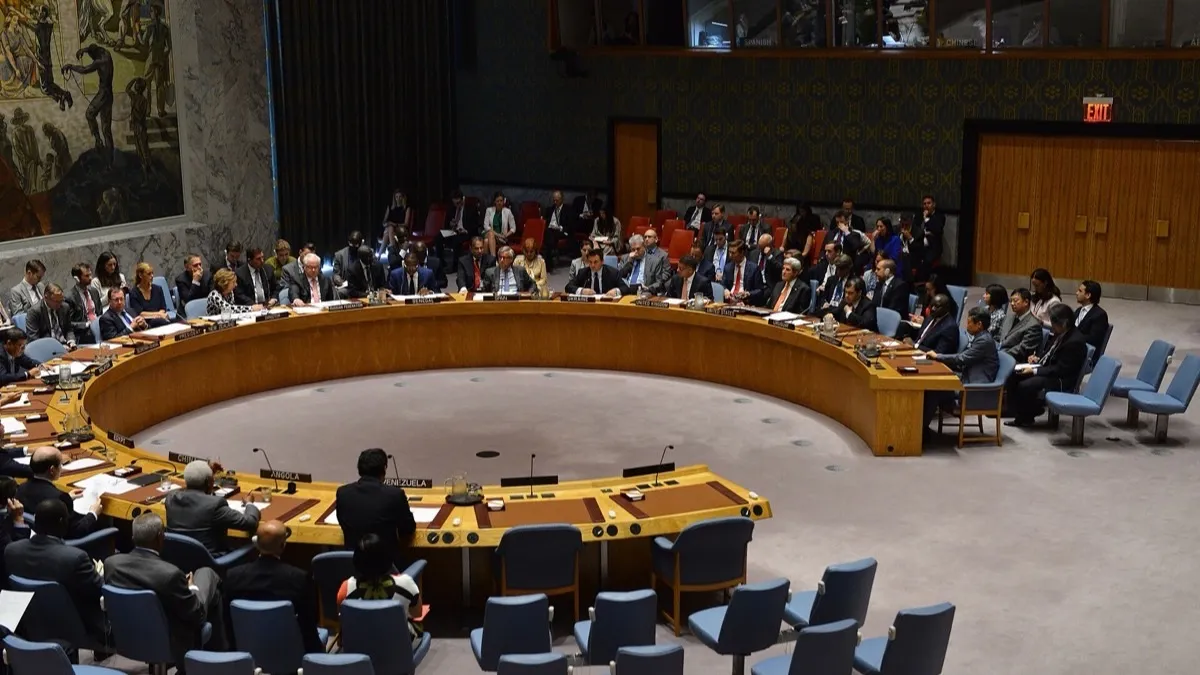
When a war breaks out or a crisis threatens international peace, one body in New York has the power to impose sanctions, authorize peacekeeping missions and even approve the use of force: the United Nations Security Council. It is also one of the most criticized institutions in the world, because on many of the biggest issues it ends up doing nothing at all.
Both facts come from the same design decision made in 1945.
What the Security Council is
The UN Charter, signed in 1945 at the end of the Second World War, gave the Security Council the main responsibility for maintaining international peace and security. Unlike the General Assembly, where all member states vote, the Council’s decisions can be binding on every UN member. That makes it uniquely powerful.
Who sits on it
The Council has 15 members:
- Five permanent members: China, France, Russia, the United Kingdom and the United States. These were the main victorious powers of the Second World War, and their seats have not changed since.
- Ten elected members, chosen by the General Assembly for two-year terms. Five are elected each year, seats are shared out by world region, and a country cannot serve two terms in a row.
The presidency of the Council rotates every month among its members, in English alphabetical order. The president chairs meetings and sets the agenda for that month.
How decisions are made
On most substantive questions, a resolution needs at least nine votes in favor out of fifteen. But there is a catch: it must also avoid a “no” vote from any of the five permanent members. A single “no” from one of them blocks the resolution, no matter how many others support it. That is the veto.
By long-standing practice, a permanent member that abstains does not block a resolution. Only an actual vote against counts as a veto.
What the Council can do
- Call on parties to a conflict to negotiate or observe a ceasefire.
- Impose sanctions, such as arms embargoes, travel bans and asset freezes.
- Create and renew peacekeeping missions.
- Refer situations to the International Criminal Court.
- Authorize the use of force when other measures fail.
Under Chapter VII of the Charter, its decisions on threats to peace are binding, although the UN has no army of its own and relies on member states to enforce them.
The veto in practice
The veto was the price of getting the major powers to join the UN at all. Without the guarantee that they could block actions against their core interests, the organization would likely not have existed, or would have repeated the failure of the League of Nations.
The cost is obvious. When a permanent member is a party to a conflict, or protects a close ally, the Council is often paralyzed. Russia vetoed a resolution condemning its 2022 invasion of Ukraine. The United States has used its veto many times on resolutions about Israel and the Palestinian territories. China and Russia have vetoed resolutions on Syria. Each side accuses the others of abusing the power.
Workarounds and reform
Since 2022, a General Assembly rule requires the Assembly to meet within days whenever a veto is cast, so the country that used it must explain itself in front of all UN members. That adds political pressure but doesn’t change the outcome.
Calls to reform the Council are decades old. Proposals include adding permanent seats for countries such as Brazil, Germany, India and Japan, giving Africa permanent representation, or limiting the veto in cases of mass atrocities. Every major change requires amending the UN Charter, and amendments themselves can be vetoed by any permanent member. So reform keeps stalling.
What we think
It is easy to call the Security Council broken, but it works roughly as designed. It was built to keep the great powers inside one system and to prevent the UN from going to war against any of them. In that narrow sense, it has succeeded.
The real test is whether it can stay relevant when the world’s biggest crises involve those same powers. Until the permanent members agree to limit their own privileges, the Council will remain most effective on the conflicts the great powers care least about.